
 English
 Español
 عربى
عربى
How Crystal Gel Beads Air Fresheners Work: A Complete Guide
Content
- 1 What Crystal Gel Beads Air Fresheners Are and How They Work
- 2 Product Range Overview: Comparing the 500g, 240ML and 320g Formats
- 3 How to Position and Maintain Crystal Gel Beads for Best Results
- 4 Market Share Distribution Across the Global Air Freshener Category
- 5 Growth Trajectory of the Air Freshener and Home Fragrance Market
- 6 Where Crystal Gel Beads Fit Within Residential and Commercial Demand
- 7 Comparing Fragrance Delivery Formats: Gel Beads, Sprays, Candles and Plug In Diffusers
- 8 Manufacturing Process and Quality Control Behind Every Batch
- 9 Practical Applications Across Homes, Hospitality and Retail Environments
- 10 Private Label and Wholesale Manufacturing Options for Business Buyers
- 11 About Ningbo Habest Home Co., Ltd.
- 12 Frequently Asked Questions About Crystal Gel Beads Air Fresheners
- 12.1 Q1: What are crystal gel beads air fresheners made of
- 12.2 Q2: How long does a gel bead air freshener typically last
- 12.3 Q3: Can crystal gel beads be private labeled for a retail brand
- 12.4 Q4: What is the difference between the 240ML, 500g and 320g formats
- 12.5 Q5: Are crystal gel beads suitable for small spaces like cars or bathrooms
- 12.6 Q6: Does a gel bead air freshener manufacturer support wholesale and bulk supply
What Crystal Gel Beads Air Fresheners Are and How They Work
Air Fresheners Crystal Gel Beads are solid, translucent fragrance carriers that hold scented oil inside a stabilized gel matrix and release it gradually through natural evaporation, offering a low maintenance alternative to sprays, candles, or plug in devices for homes, vehicles, and commercial spaces. This is the direct answer to how the format works: the gel structure, most commonly built on a polyacrylate or hydrocolloid base, is engineered to absorb and hold several times its own weight in fragrance oil, then slowly release fragrance molecules from the exposed surface as ambient temperature and airflow interact with the beads. This mechanism explains why gel bead formats are frequently selected by manufacturers and retailers seeking a display friendly, no spill fragrance product that does not require batteries, an open flame, or a power outlet.
Unlike aerosol sprays that release most of their fragrance dose within seconds and then dissipate, or candles that require supervised burning, crystal gel beads sit openly in a jar or container and diffuse fragrance passively over an extended period. Actual diffusion speed is influenced by room size, airflow, ambient temperature, and the surface area of gel exposed to open air. According to a widely referenced overview of gel based air freshener formulations, polyacrylate gel matrices are the most common carrier used in commercial air freshener production because of their high absorption capacity and structural durability, and this same category of gel technology underpins the aroma crystal beads and odor eliminator gel beads discussed throughout this guide.
A few practical characteristics tend to define this product category across the industry:
- Fragrance release happens mainly through surface evaporation, so beads with more exposed surface area generally diffuse fragrance more noticeably in the early stage of use
- Warmer environments and greater airflow tend to accelerate the release rate, while cooler and more enclosed spaces slow it down
- The gel matrix functions as a passive fragrance reservoir, requiring no electricity, flame, or mechanical pump to operate
- Because the beads are visually appealing and available in different colors and container styles, they are often positioned as both a decorative and functional item in retail and hospitality settings
This shared gel technology forms the foundation for several product formats offered within this category, including aroma gel beads designed for whole room use and odor eliminator gel beads formulated for more targeted odor control in smaller spaces. The next section compares three common formats side by side so buyers can match the right package size to the right application.
From a composition standpoint, most commercial gel air fresheners combine four general categories of ingredients: a gelling agent that forms the solid matrix, a solvent or water base that helps distribute the fragrance evenly, fragrance oil that provides the scent itself, and small amounts of preservative or stabilizing ingredients that help the gel maintain its shape and consistency over the product's shelf life. Reputable manufacturers generally document raw material sourcing and formulation ratios as part of standard quality control, which allows retail buyers and private label partners to request formulation transparency before committing to a supply agreement. Buyers evaluating a new gel bead supplier for the first time often ask about ingredient documentation, fragrance oil sourcing, and batch consistency testing, since these factors directly affect how uniform the finished aroma gel beads will be from one production run to the next.
Product Range Overview: Comparing the 500g, 240ML and 320g Formats
Buyers sourcing crystal gel beads air fresheners typically need a package size and container style that matches a specific shelf position, room type, or branding program. The three formats compared below share the same underlying gel technology described above but are built around different container sizes, fragrance intensity profiles, and intended use cases, which allows retail buyers, distributors, and private label partners to select the configuration that best fits their target application.
| Product Format | Package Size | Primary Focus | Typical Setting | Notable Characteristic |
|---|---|---|---|---|
| 500g Luxury Wonderful Aroma Gel Beads | 500 grams | Whole room ambiance | Living rooms, boutique retail, gift sets | Larger bead volume intended for broader room coverage |
| 240ML Clear Air Odor Eliminator Gel Beads | 240 milliliters | Targeted odor elimination | Bathrooms, kitchens, small rooms, vehicles | Clear gel formulation designed for compact spaces with visible odor concerns |
| 320g Private Label Aroma Crystal Beads | 320 grams | Custom branding programs | Retail chains, distributors, private label brands | Mid size format built specifically for OEM and private label branding |
In practice, buyers evaluating these three formats generally start by identifying the room size or use case they need to serve, then layer in packaging preferences such as a clear container for a more minimalist look or a labeled jar built for a private label program. The 240ML clear format tends to suit compact spaces where odor control is the primary concern, while the 500g and 320g formats are more commonly positioned for whole room fragrance and for retail or private label distribution respectively.
How to Position and Maintain Crystal Gel Beads for Best Results
Getting the most consistent performance from any crystal gel beads air freshener generally comes down to a few practical placement and handling habits rather than any special technique. Because the release mechanism relies on passive evaporation, small differences in where and how the container is positioned can noticeably affect how the fragrance is experienced in a room. The following practical guidance is drawn from the general evaporation principles discussed earlier in this guide and applies broadly across the 500g, 240ML, and 320g formats compared above.
- Remove any protective film or seal completely before use, since a partially sealed surface will restrict airflow and slow the initial release of fragrance
- Place the container in a location with reasonable airflow rather than a fully sealed cabinet, since airflow across the gel surface is part of what carries fragrance molecules into the surrounding space
- Keep the product away from direct, prolonged sunlight or heat sources, since higher temperatures generally accelerate evaporation and can shorten how long the fragrance remains noticeable
- Position gel bead jars on a stable, level surface out of reach of small children or pets, consistent with general household safety practice for any home fragrance product
- For smaller enclosed spaces such as a car interior or a closet, a compact format like the 240ML clear odor eliminator gel beads is generally a better fit than a larger jar intended for whole room coverage
- Store unopened units in a cool, dry location prior to use, which helps preserve the intended fragrance profile until the container is opened
These are general handling habits rather than strict requirements, and most users will find that simply opening the container and placing it in a reasonably ventilated area is sufficient to achieve the passive, low maintenance experience that crystal gel beads are generally chosen for. Retailers and private label partners distributing these products to consumers may find it useful to include a short usage note along these lines on packaging or point of sale materials, since clear placement guidance tends to improve how consistently end users experience the product.
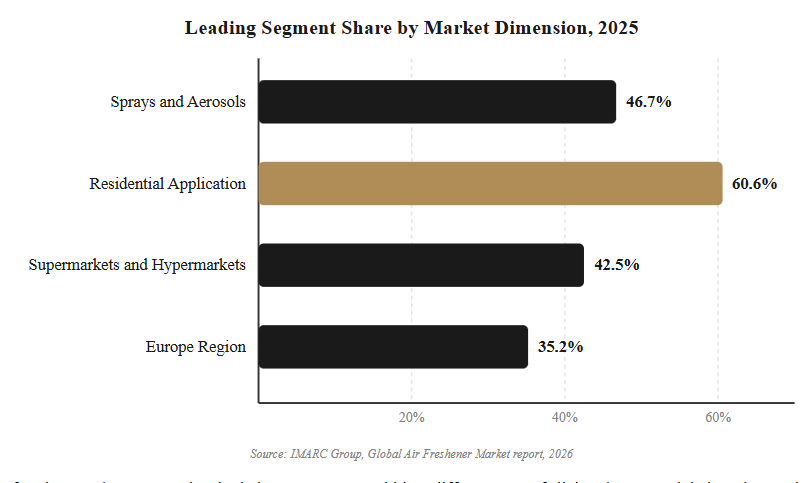
Understanding where crystal gel beads sit within the wider air freshener category starts with a clear picture of how the overall market is currently structured. Industry research helps explain why certain formats, retail channels, and use cases dominate current demand, and why gel based products continue to hold a meaningful position within that structure. The chart below summarizes four separate market dimensions, each showing the leading segment within that dimension using 2025 figures. Reviewing these figures side by side gives buyers, distributors, and private label partners a practical reference point when planning inventory, marketing angles, or new product listings. The horizontal bar chart that follows visualizes these four leading shares so the relative scale of each is easy to compare at a glance.
Source: IMARC Group, Global Air Freshener Market report, 2026
These four bars each represent the single largest segment within a different way of slicing the same global market, and together they sketch a useful picture of where demand concentrates. Sprays and aerosols hold the largest product type share at 46.7 percent, which the underlying report attributes to ease of use, instant application, and broad availability across both premium and value priced retail tiers. Gel based air fresheners are tracked by the same research as a separate, recognized product type alongside sprays, electric diffusers, and candles, which confirms that gel formats occupy their own established lane within the category rather than functioning as a niche afterthought. Residential use leads the application breakdown at 60.6 percent, reflecting how much of this market is driven by everyday household purchasing rather than commercial or automotive use, which is a meaningful signal for any format, including crystal gel beads, that is positioned primarily for home use. Supermarkets and hypermarkets remain the leading distribution channel at 42.5 percent, underscoring the continued importance of physical retail shelf presence even as online channels expand. Europe holds the largest regional share at 35.2 percent, a pattern the underlying research links to strong regional awareness of indoor air quality and a consumer preference for premium, eco conscious formulations. For a supplier or private label partner evaluating where to introduce Air Fresheners Crystal Gel Beads, these figures suggest that residential focused positioning, physical retail availability, and alignment with premium or eco friendly messaging are all reasonable strategic priorities rather than assumptions. Because gel air fresheners are tracked as their own category within this research, buyers can reasonably treat crystal gel beads and aroma crystal beads as a distinct, monitored segment of the broader industry rather than a generic subcategory of sprays or candles. Taken together, this data supports treating crystal gel beads as a format with genuine category recognition, meaningful residential demand, and clear relevance to the retail and regional patterns that currently define the wider air freshener market.
Growth Trajectory of the Air Freshener and Home Fragrance Market
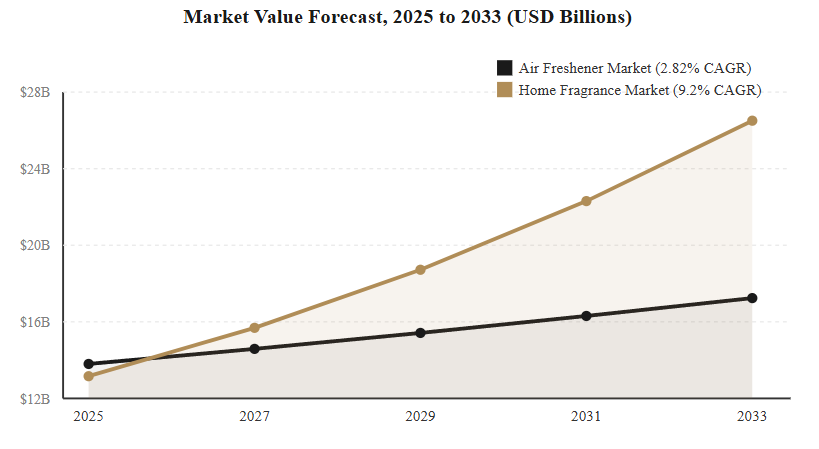
Beyond understanding today's market structure, it helps to see where the category is heading over the next several years. Growth projections give manufacturers, distributors, and private label buyers a sense of whether now is a reasonable time to expand a product line or add new formats such as crystal gel beads to an existing catalog. Two related but distinct categories are useful to compare here: the narrowly defined air freshener market, which includes sprays, gels, candles, and electric diffusers, and the broader home fragrance market, which also includes items like reed diffusers and scented decor. The chart below plots both growth curves from 2025 forward using the compound annual growth rate reported for each category by its respective industry analysis. Comparing the two lines side by side shows a meaningfully different growth pace between the narrower and broader category definitions.
Source: IMARC Group, 2026 report (air freshener line); separate 2026 home fragrance industry overview (home fragrance line). Intermediate points calculated from each source's reported compound annual growth rate.
The darker line traces the narrowly defined air freshener market, which industry research values at approximately 13.8 billion US dollars in 2025 and forecasts to grow at a 2.82 percent compound annual growth rate through the early 2030s, reaching close to 17.9 billion US dollars by 2034. That growth rate is steady but modest, consistent with a mature category where consumer habits around sprays, gels, and plug ins are already well established. The gold line traces the broader home fragrance market, which a separate 2026 industry overview values at approximately 13.16 billion US dollars in 2025 and projects to grow at a considerably faster 9.2 percent compound annual growth rate, reaching roughly 26.51 billion US dollars by 2033. The gap between these two lines widens noticeably from 2029 onward, which illustrates that the categories adjacent to traditional air fresheners, including scented decor, reed diffusers, and premium gel formats, are expanding at a meaningfully faster pace than the narrower air freshener definition alone. It is worth noting that these two figures come from separate research firms with different scope definitions and methodologies, so they should be read as directionally informative rather than perfectly comparable line items. For manufacturers and private label buyers, this divergence is a practical signal that positioning crystal gel beads within the language and marketing context of home fragrance and lifestyle scenting, rather than as a purely functional deodorizing product, may align more closely with the faster growing segment of overall demand. Steady growth in the base air freshener category also means that established retail channels for gel based products are not shrinking, which supports continued wholesale and private label opportunities for formats such as the 500g and 320g aroma gel bead options described earlier in this guide.
Where Crystal Gel Beads Fit Within Residential and Commercial Demand
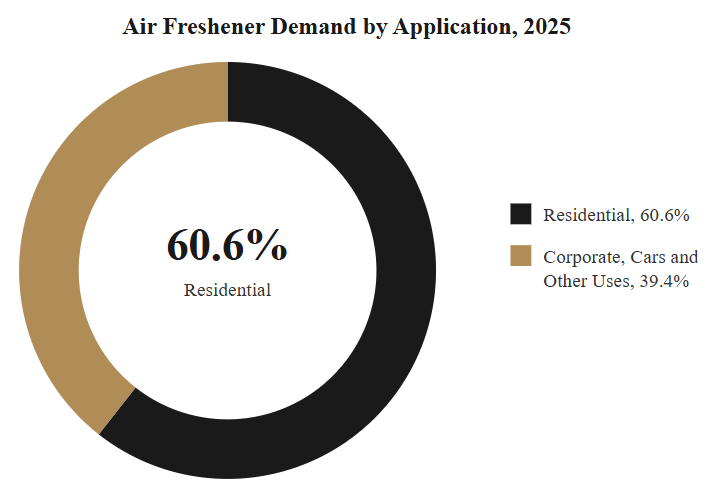
Knowing which buyer segment drives most of the demand for air fresheners helps clarify how crystal gel beads should be marketed and merchandised. Application data breaks total demand into residential use versus all other use cases combined, including corporate offices, vehicles, and other commercial settings. This distinction matters because household buyers tend to prioritize different attributes, such as visual appeal and passive convenience, compared with commercial buyers who may prioritize consistent replacement schedules or bulk purchasing. The donut chart below shows this split using the same 2025 industry data referenced earlier in this guide. Reviewing this proportion helps explain why so many gel bead product lines, including the 500g and 240ML formats described above, are designed with home environments as the primary target use case.
Source: IMARC Group, Global Air Freshener Market report, 2026
The dark segment shows that residential buyers account for roughly six in every ten dollars spent within the global air freshener category, making households by a clear margin the largest single buyer group. The gold segment groups together corporate offices, vehicles, and other commercial or institutional settings, which together make up just under forty percent of the market. This split has several practical implications for anyone sourcing or marketing crystal gel beads air fresheners. First, it suggests that packaging, fragrance intensity, and marketing language built around home use cases, such as bedrooms, bathrooms, closets, and living rooms, are likely to resonate with the largest available buyer pool. Second, it does not mean commercial and automotive use should be ignored, since almost forty percent of the market still comes from those combined settings, and vehicles in particular are a well established use case for compact gel formats like the 240ML clear option. Third, private label partners building a retail assortment around crystal gel beads can reasonably prioritize home focused shelf placement, such as household goods or bath and body sections, while still offering a smaller format suited to cars or offices as a secondary line extension. The concentration of demand in residential use also aligns with the earlier finding that supermarkets and hypermarkets are the leading distribution channel, since these are the retail environments where household buyers most commonly purchase air care products. Taken together, the residential dominance shown in this chart reinforces that crystal gel beads, aroma gel beads, and odor eliminator gel beads are fundamentally household oriented products, even as meaningful secondary demand continues from commercial and automotive settings. Manufacturers evaluating where to focus new product development or private label proposals can use this application split as a starting point for prioritizing home centric formats first.
Comparing Fragrance Delivery Formats: Gel Beads, Sprays, Candles and Plug In Diffusers
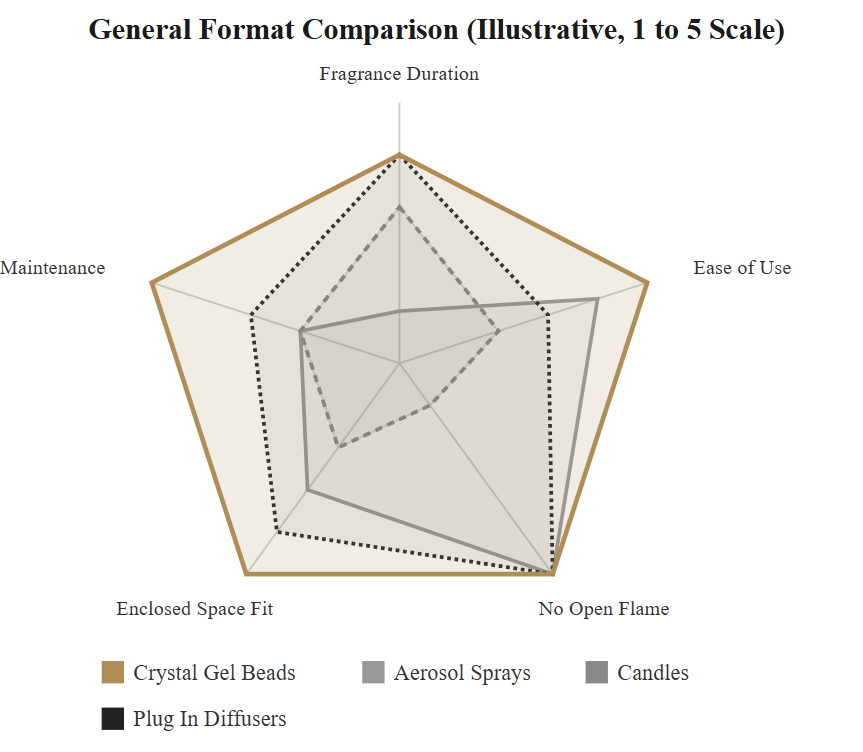
Buyers new to the category often want a general sense of how crystal gel beads compare to other common fragrance delivery formats on practical, everyday attributes. The comparison below is a qualitative characterization based on widely understood, general properties of each format rather than a single controlled laboratory study, and it is intended as a starting reference point rather than a precise scientific measurement. Five practical attributes are compared across four common formats: fragrance duration, ease of use, whether an open flame is required, suitability for enclosed spaces, and overall maintenance effort. The radar chart below plots each format across all five attributes on a simple one to five scale, where a larger shape generally indicates more favorable characteristics across more dimensions. This kind of side by side view is useful for retail buyers deciding which formats to stock together or for consumers comparing options for a specific room.
Illustrative comparison based on general, well established product characteristics rather than a single controlled study
On the fragrance duration axis, gel beads and plug in diffusers generally score higher than aerosol sprays, since a single application of spray tends to dissipate within minutes while a gel bead jar or a diffuser cartridge can continue releasing fragrance for an extended period. Candles fall somewhere in the middle on duration, since a candle can provide fragrance over multiple burning sessions but only while actively lit and supervised. On ease of use, aerosol sprays and gel beads both score favorably because they require no setup beyond opening the container or pressing a nozzle, while plug in diffusers require access to an outlet and periodic refill management, and candles require matches or a lighter along with ongoing attention while burning. The open flame axis highlights one of the clearest practical differences in the category: gel beads, sprays, and plug in diffusers all operate without any flame, while candles inherently require one, which is an important safety consideration in households with children, pets, or limited supervision. On suitability for enclosed spaces such as closets, cars, or small bathrooms, gel beads tend to perform well because they diffuse gradually without combustion byproducts, while candles are generally less suited to small unventilated spaces due to soot and open flame concerns. Finally, on overall maintenance effort, gel beads again tend to score favorably since they need no refilling, charging, or active supervision until the gel is fully depleted, whereas sprays require frequent reapplication and diffusers require occasional cartridge changes. Viewed together, this comparison helps explain why crystal gel beads are frequently chosen for spaces where a set it and forget it approach to fragrance is preferred, such as closets, vehicles, and bathrooms, while still acknowledging that sprays and diffusers each offer their own distinct advantages for different situations.
Manufacturing Process and Quality Control Behind Every Batch
A crystal gel bead air freshener moves through several distinct production stages before it reaches a retail shelf or a private label customer's warehouse. The illustration below presents a simplified three dimensional view of a finished gel bead jar with its main functional components labeled, which helps clarify what buyers are actually evaluating when they compare container designs across different suppliers.
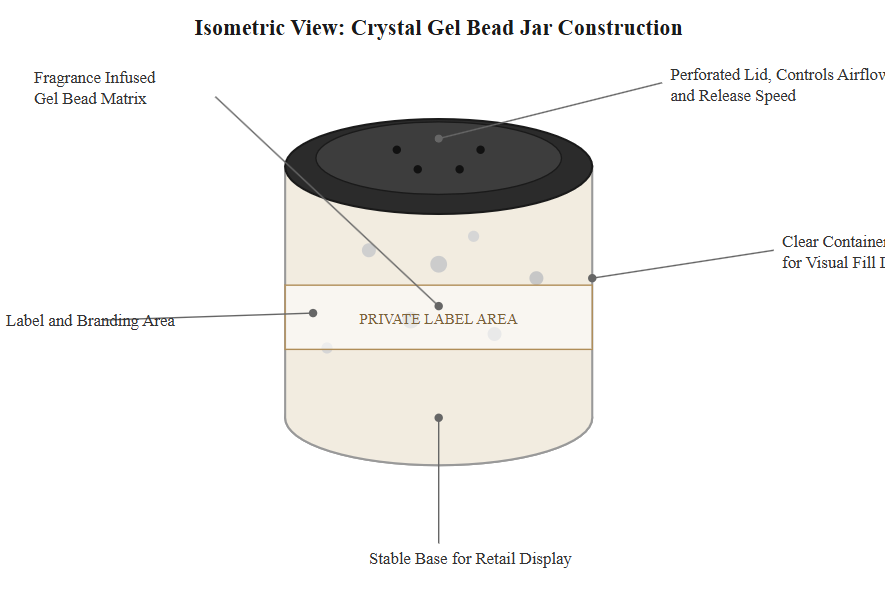
Behind this finished jar sits a structured production process. Raw materials, including the gel forming agents, fragrance oils, and packaging components, are inspected on arrival before entering production, which is the first checkpoint in maintaining consistent quality across batches. The gel matrix is then prepared and blended with the selected fragrance oil at controlled ratios, followed by filling into the jar or bottle format, sealing, and a final visual and functional inspection before the product is packed for storage or shipment. This sequence generally follows the order below:
- Raw material inspection and storage under controlled conditions
- Gel matrix preparation and fragrance oil blending at set ratios
- Filling into the jar, bottle, or private label container format
- Sealing, lid perforation, and finished unit inspection
- Packing, warehousing, and preparation for domestic or export shipment
Ningbo Habest Home Co., Ltd. operates its production around this same structured philosophy, working across every stage from development and raw material control through manufacturing, quality control, storage, and transportation, based on the belief that consistent quality comes from disciplined process control at each individual step rather than inspection at the end alone. This approach applies equally to standard catalog items and to private label crystal gel bead programs built to a customer's own container and branding specifications.
Practical Applications Across Homes, Hospitality and Retail Environments
Crystal gel beads air fresheners are used across a wide range of settings, and understanding these common applications helps buyers select the right format, fragrance strength, and container style for their intended market. The versatility of this format is one of the reasons it appears consistently across so many different retail categories, from household goods and bath accessories to automotive aftermarket products and hospitality supply catalogs. Because the underlying gel technology does not depend on electricity, flame, or mechanical parts, the same core product can generally be repackaged and relabeled to suit household, automotive, and light commercial applications without changing the fundamental formulation. The following list summarizes the most common use cases observed across the category:
- Residential rooms such as bedrooms, living rooms, and closets, where a larger format like the 500g aroma gel beads can provide broader room coverage
- Bathrooms and kitchens, where compact odor focused formats such as the 240ML clear gel beads are commonly placed to address specific odor sources
- Vehicles, where small jars or clip in gel formats offer continuous fragrance without the mess associated with liquid sprays
- Hospitality environments such as hotel rooms, spas, and guest bathrooms, where passive, low maintenance fragrance supports a consistent guest experience
- Retail and gift assortments, where decorative jar designs and private label branding, such as the 320g private label aroma crystal beads format, support seasonal or promotional product lines
- Offices and small commercial spaces, where a flame free, low maintenance format reduces the operational burden of managing fragrance across multiple rooms
Across all of these environments, the shared advantage of gel bead formats is passive operation. There is no need to remember to reapply a spray, monitor an open flame, or manage a power connection, which is part of why this format continues to appear across such a broad range of residential and commercial applications discussed throughout this guide. Retail buyers building a home fragrance assortment often find it practical to stock more than one format side by side, pairing a larger whole room jar for the living room or bedroom category with a compact odor focused option for the bath and car care sections, since this mirrors how many households naturally use gel bead air fresheners in more than one room at a time.
Private Label and Wholesale Manufacturing Options for Business Buyers
For retailers, distributors, and brand owners evaluating suppliers, the ability to source crystal gel beads through a private label or original equipment manufacturing arrangement is often a central consideration. A private label air freshener manufacturer typically handles fragrance development, gel formulation, container sourcing, filling, and quality control, while the buyer focuses on branding, marketing, and distribution. This division of responsibility allows a retail brand or distributor to bring a customized aroma gel beads product to market without building its own production infrastructure.
Several factors are commonly considered by wholesale buyers and private label partners when selecting a gel bead air freshener manufacturer:
- Whether the factory can support custom container shapes, label designs, and fragrance profiles for a private label crystal gel beads program
- Production capacity and the number of dedicated production lines available to support consistent bulk supply for wholesale distribution
- Documented raw material control and quality control procedures throughout development, manufacturing, storage, and transportation
- Experience supplying international retail and distribution customers across different regions and regulatory environments
- Flexibility across multiple package formats, such as the 500g, 240ML, and 320g options described earlier, to serve different retail categories from a single supplier relationship
This kind of full service private label and wholesale manufacturing model is particularly relevant for buyers seeking a single, consistent supplier for a home fragrance category that includes crystal gel beads, aroma gel beads, and odor eliminator gel beads across several package sizes, rather than working with multiple disconnected vendors for each format.
It is also useful to understand the general distinction between private label and original equipment manufacturing arrangements when evaluating a gel bead air freshener manufacturer. Under a private label model, the buyer generally selects from an existing catalog of gel formulations and container options, then applies its own label and branding, which tends to support a faster path to market. Under an original equipment manufacturing arrangement, the buyer works more closely with the manufacturer on a customized fragrance profile, container shape, or gel formulation built specifically for that brand, which typically requires more development time but allows for a more differentiated final product. Many wholesale suppliers and distributors work with a manufacturer across both models simultaneously, using private label formats such as the 500g and 240ML options for faster moving retail categories while reserving a more customized original equipment manufacturing approach, such as the 320g private label aroma crystal beads format, for flagship or signature product lines. Choosing between these two approaches generally depends on how quickly a buyer needs to launch, how differentiated the fragrance or packaging needs to be, and how much internal capacity the buyer has to manage a longer development cycle with the manufacturer.
About Ningbo Habest Home Co., Ltd.
Ningbo Habest Home Co., Ltd. was established in Ningbo, China in 2012. The factory covers 6,500 square meters and operates 5 production lines equipped with professional equipment, and the company has continued to provide home fragrances, candles, and other home decoration products to customers with a focus on diversification and rapid research and development capability. Habest has developed long term business relationships with customers across Japan, the United States, the European Union, and the United Kingdom, and its international customer base includes retail and consumer goods companies such as DAISO JAPAN, AUCHAN, CROWN HOME, DOLLAR TREE, AVON, NIVEA, FBC, fatigati casa, and KIK.
The company's operating philosophy is that trust comes from quality. This principle is applied across every stage of the production process, from development and raw material control through manufacturing, quality control, storage, and transportation, with the goal of maintaining consistent standards across every batch of crystal gel beads air fresheners and other home fragrance products the company produces, whether for standard catalog orders or private label and wholesale programs built around a customer's own specifications.
Frequently Asked Questions About Crystal Gel Beads Air Fresheners
Q1: What are crystal gel beads air fresheners made of
A1: Crystal gel beads air fresheners are generally made from a gel forming base, most commonly a polyacrylate or hydrocolloid matrix, combined with fragrance oil, water, and stabilizing ingredients. The gel structure holds the fragrance oil in place and allows it to release gradually through surface evaporation rather than all at once.
Q2: How long does a gel bead air freshener typically last
A2: Industry references commonly describe gel based air fresheners as lasting several weeks under normal conditions, with actual duration depending on room size, airflow, temperature, and how much of the gel surface is exposed to open air. Placement in a smaller, more enclosed space generally extends how long the fragrance remains noticeable.
Q3: Can crystal gel beads be private labeled for a retail brand
A3: Yes, private label crystal gel beads programs are a common arrangement in this category, where a manufacturer handles gel formulation, fragrance blending, container sourcing, and quality control while the buyer applies its own branding and label design. The 320g private label aroma crystal beads format described earlier in this guide is one example built specifically for this kind of program.
Q4: What is the difference between the 240ML, 500g and 320g formats
A4: The 240ML clear format is generally suited to compact spaces where odor elimination is the main concern, the 500g format is designed for broader whole room coverage, and the 320g format is a mid size option commonly used for private label and retail branding programs. Buyers typically choose among these based on the room size and branding needs of their specific application.
Q5: Are crystal gel beads suitable for small spaces like cars or bathrooms
A5: Yes, gel bead formats are commonly used in small enclosed spaces such as vehicles, bathrooms, and closets, since the passive evaporation mechanism does not require electricity or open flame and tends to build a noticeable fragrance concentration in confined areas. Compact clear formats such as the 240ML odor eliminator gel beads are frequently chosen for this type of application.
Q6: Does a gel bead air freshener manufacturer support wholesale and bulk supply
A6: Manufacturers that operate multiple dedicated production lines are generally equipped to support wholesale and bulk supply arrangements for distributors and retail chains, in addition to standard retail size orders. Buyers evaluating a wholesale supplier for crystal gel beads typically confirm production capacity, available package formats, and private label options as part of the sourcing process before finalizing a supply relationship.


 INTERACT WITH US
- Phone:+86-15888548612
- Tel:+86-0574-88408268
- E-mail:[email protected]
- Address:312 Kemao Road, Jishigang Town, Haishu District, Ningbo City, Zhejiang Province, China.



