
 English
 Español
 عربى
عربى
Calming Home Fragrance Manufacturer Guide for Wholesale and Retail Buyers
Content
- 1 Calming Is a Brief, Not a Scent: Turning One Word Into a Specification
- 2 Calming Reed Diffusers: Continuous, Flameless Background Scent
- 3 Calming Scented Candles: Warm Light and a Shorter, Softer Window
- 4 Matching Calming Products to Rooms, Channels and Price Points
- 5 Sampling, Testing and Compliance for Calming Fragrance Programs
- 6 Six Sourcing Mistakes That Quietly Undo a Calming Range
- 7 Working With a Calming Home Fragrance Manufacturer
- 8 FAQ: Calming Home Fragrance Questions From Buyers and Product Teams
- 8.1 What makes a fragrance feel calming rather than sweet or heavy?
- 8.2 Can the same fragrance oil be used in a reed diffuser and a candle?
- 8.3 How many reeds should a calming reed diffuser ship with?
- 8.4 Do calming products need allergen and safety documentation?
- 8.5 What is a realistic minimum order for a private label calming diffuser?
- 8.6 How should calming claim wording be handled on the pack?
- 8.7 Are flameless diffusers the better choice for homes with children or pets?
- 8.8 Which calming format should a first-time buyer start with?
A buyer at a European homeware chain sends a one-line brief: we need calming products for the spring shelf. No scent family, no format, no price point. Just the word calming.
That brief lands in our inbox most weeks, and it is usually one of the easiest to answer, because calming is not a fragrance name. It is a promise about a room, a mood and a moment of the day, and the product only keeps that promise when the format, the scent load, the vessel and the label all agree with each other. A calming reed diffuser and a calming candle can be built from the same fragrance oil and still feel like two completely different products to the shopper who picks them up.
Ningbo Habest Home Co., Ltd. has been building home fragrance for international retail since 2012, from a 6,500 square metre factory with five production lines in Ningbo, China. We work as an ODM and OEM manufacturer for supermarket chains, discount networks, brand owners and distributors across Japan, the United States, the European Union and the United Kingdom, and we hold BSCI and WCA factory certifications. This guide is the calming conversation we have with buyers, category managers and product developers, written so that it can be used directly in a brief.
The short answer comes first. Calming sells best as a flameless reed diffuser for continuous background scent, a soy wax candle for warm and shorter evening moments, and a solid fragrance, sachet or bead product for small closed spaces. Everything below explains why that ordering holds up, and what to watch when you specify each one.
Calming Is a Brief, Not a Scent: Turning One Word Into a Specification
When a retail brief says calming, it usually carries three hidden variables that nobody wrote down: the room, the moment, and the shopper. A twelve square metre bedroom used mainly for sleeping asks for something very different from a forty square metre open-plan living area. A product used at ten in the evening asks for a quieter scent profile than one reached for during a morning tidy-up. Getting those variables onto paper before the first sample is what separates a calming range that reorders from one that ends up in the markdown bin.
What buyers actually mean when they say calming
In practice, calming covers three distinct purchase motivations, and they do not always want the same product. The first is a wind-down ritual: a scent that signals the working day is over, used at a fixed time in a fixed room. The second is gifting, where the buyer is not shopping for themselves and wants a scent that is difficult to dislike. The third is neutralisation, where the customer wants a room to smell clean and quiet rather than perfumed, and where anything that reads as a strong air freshener will be rejected.
Each motivation points to different decisions. Ritual buyers will accept a slightly more distinctive fragrance and will pay for a heavier glass bottle, because the product is on display. Gift buyers respond to vessel shape and packaging copy more than to top notes. Neutralisation buyers care about how the scent behaves after two weeks, not in the first ten minutes, which makes the carrier base and reed quality far more important than the headline accord.
Four calming directions that keep their character on shelf
Across the calming briefs we receive, four scent directions do most of the work. They are broad enough to be safe in a chain store and specific enough to feel like a real idea rather than a generic soft scent.
- Soft floral and herbal floral. Lavender, chamomile, iris and powdery rose. The widest recognition and the fastest to explain on a shelf label, but also the most crowded, so the difference usually has to come from the quality of the top note rather than the name.
- Warm woody and amber. Sandalwood, cedar, cashmere wood and soft amber. Reads as more premium and suits higher price tiers, hotels and gift sets. In diffusers these accords also mask the slight solvent edge of the carrier base better than light florals do.
- Clean musk and cotton. Laundry-adjacent, powder-dry, close to skin. Popular in bedroom and wardrobe products, and often the easiest to place next to existing home textiles in the same aisle.
- Green and aromatic. Eucalyptus, white tea, bamboo and verbena. Fresher and slightly sharper, well suited to bathrooms, entryways and summer programs, but more sensitive to over-dosing because the aromatic top notes turn harsh when the load is pushed too high.
Why the format decides the calming story before the fragrance does
A fragrance that feels calm in a candle can feel thin in a diffuser, and the same oil can feel aggressive in a spray. The reason is release behaviour. A candle releases scent in bursts tied to burning sessions and reaches a room quickly, which suits a short, focused moment. A reed diffuser releases a low, continuous trickle for weeks, which suits a room that should never announce the product. A solid fragrance or sachet releases very slowly into a closed volume such as a drawer, a wardrobe or a car, where there is almost no airflow to carry it away.
That is why we ask about the room before we ask about the scent. If the answer is a bedroom used for eight hours of sleep, the diffuser is usually the right vehicle and the candle is the emotional add-on. If the answer is a hallway or a bathroom with constant foot traffic, a diffuser will often be overwhelmed and the fresher end of the range performs better.
Calming Reed Diffusers: Continuous, Flameless Background Scent
If a retailer can only carry one calming format, this is normally the one we recommend. The flameless reed diffuser has no ignition risk, needs no attention from the customer, and delivers a scent level that is present but rarely overwhelming. It also photographs well, which matters more than most sourcing teams expect, because a large share of home fragrance sales now starts on a screen.
How a flameless reed diffuser keeps a room steady
A reed diffuser works by capillary action. The fragrance oil, typically 15 to 25 percent fragrance concentrate blended into a low-odour carrier base such as dipropylene glycol or a cosmetic-grade isoparaffin, climbs through the porous channels inside each rattan stick and evaporates from the exposed surface. Because the output depends on airflow and ambient temperature rather than on a flame, the release stays low and even. A room at 20 to 24 degrees Celsius with normal air movement will sit in a comfortable range; a room next to a radiator or under a direct air-conditioning vent will run faster and the bottle will empty sooner.
This is also why we treat the reeds as a component rather than an accessory. Reed diameter, channel density, length and the number of sticks all change how much surface area is exposed, and therefore how strong the room smells on day three versus day thirty.
Capacity, bottle and reed count
Capacity is the single easiest lever for matching a calming diffuser to a room, and it is also the cleanest way to build a three-tier price ladder inside one range. The table below reflects the sizing logic we use in ODM development, based on typical indoor conditions rather than best-case laboratory numbers.
| Capacity | Suggested room size | Typical refill window | Retail position |
|---|---|---|---|
| 100 to 120 ml | 8 to 12 square metres | 5 to 7 weeks | Entry price, trial purchase, gift with purchase |
| 130 to 160 ml | 12 to 18 square metres | 6 to 9 weeks | Core shelf unit, bedroom positioning |
| 180 to 200 ml | 18 to 25 square metres | 8 to 12 weeks | Main offer, living room and hotel rooms |
| 250 ml and above | 25 to 35 square metres | 10 to 16 weeks | Value size, club packs, online bundles |
Reed count should scale with volume rather than being fixed. As a working rule we ship six reeds with a 100 ml bottle, eight with 150 ml, and ten to twelve with 200 to 250 ml, using 3 to 5 mm rattan sticks cut around 8 to 12 cm longer than the bottle neck. Short reeds in a tall bottle look cramped and underperform, because most of the evaporation surface ends up inside the glass where there is little airflow.
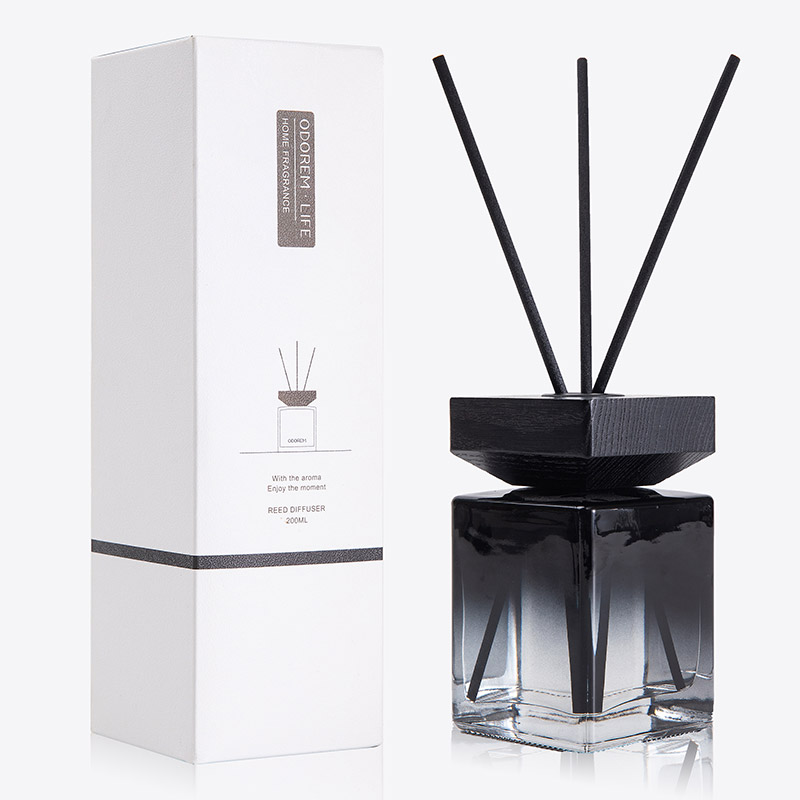
 180ml Household bedroom fireless reed diffuserPlant Extract Volatile SolutionView Product →
For bedroom-led calming programs, an 180 ml flameless diffuser hits a useful middle point: enough volume to cover a normal bedroom for two months, small enough to keep the landed cost inside a mid-tier retail price, and large enough that the shopper feels they bought a real product rather than a sample.
Calming Scented Candles: Warm Light and a Shorter, Softer Window
A candle does something a diffuser cannot. It gives the customer a ritual with a beginning and an end, a warm pool of light, and a scent that arrives quickly enough to be noticed in the first ten minutes. For calming ranges, that makes the candle the emotional centre of the shelf and the diffuser the practical backbone, and most successful programs carry both.
Wax, wick and vessel choices that change how calm a candle feels
The wax base sets the tone. Soy wax and soy-coconut blends burn cooler and slower, throw scent gently, and support the natural, quiet positioning that calming ranges rely on. Fully refined paraffin throws more strongly and holds a sharper top note, which can read as more perfumed and slightly less calm in a small bedroom. In practice, a soy or soy-blend wax with a fragrance load of around 6 to 8 percent gives the balance most calming briefs are looking for, while heavier loads above 10 percent can cause the wax to sweat, tunnel or smoke at the wick tip.
Wick selection matters just as much. A cotton wick sized too small for the vessel diameter will tunnel down the middle and leave a ring of wasted wax, which shows up as a one-star review about a candle that only burned halfway. A wick sized too large will produce a tall flame and a sooty tip. For vessels wider than 80 mm, a double wick or a wooden wick is often the cleaner answer, and both also give the product a calmer, slower visual rhythm when lit.
Burn-time math and what to print on the pack
Burn time is roughly a function of wax mass and wick behaviour, and buyers should treat printed figures as a floor rather than a target. The table below shows the ranges we typically quote for calming candles after stability and burn testing, along with the shelf role each size tends to play.
| Candle format | Wax mass | Typical burn time | Best-fit use |
|---|---|---|---|
| Small glass jar | 100 to 120 g | 18 to 25 hours | Bedside trial, bathroom shelf, gift add-on |
| Standard glass jar | 180 to 200 g | 35 to 45 hours | Core calming unit, bedroom and living room |
| Decorated jar or cement cup | 220 to 260 g | 45 to 60 hours | Gifting, seasonal sets, higher price tier |
| Large multi-wick vessel | 500 g and above | 80 to 100 hours | Statement piece, hotel lobby, home decor |
Two practical notes on claims. First, quote the conservative end of the tested range, because a customer who reaches the last centimetre of wax will feel rewarded while a customer who runs out early will feel cheated. Second, keep the scent description and the burn description separate on the pack. Calming copy works best when it describes the moment, and the technical numbers stay quietly in the specification panel.
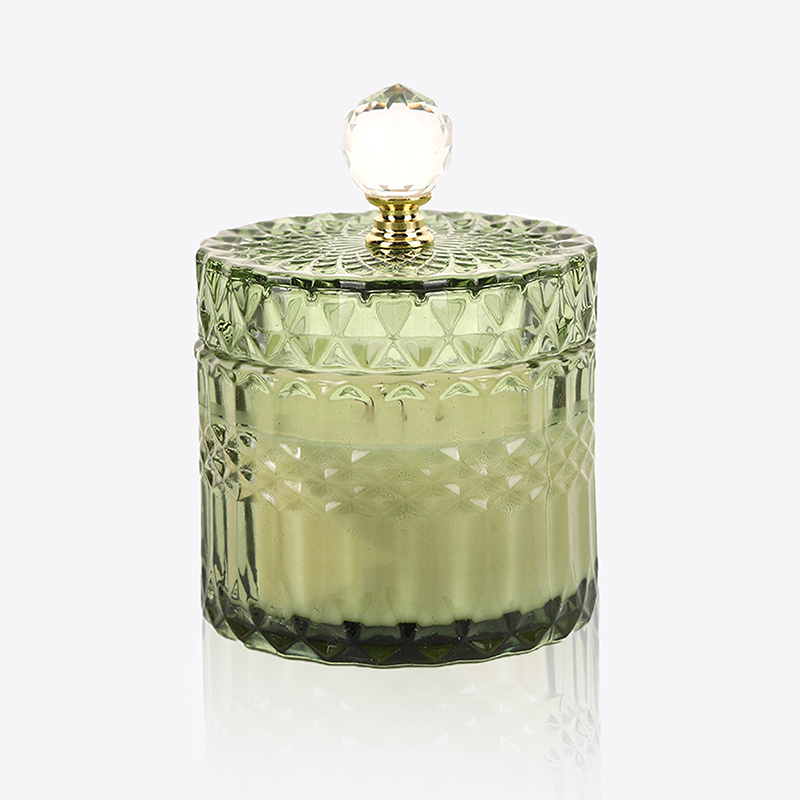 L5200B Glass jar Ogranic Eco soy wax Scented candlesOne of the biggest highlights of L5200B Glass jar Ogranic Eco soy wax Scented candles is the 100% organic soy wax they use. Soy wax is a natural plant wax that does no...View Product →
A glass jar candle in organic eco soy wax is the version most calming briefs settle on, since the transparent vessel lets the wax and any dried decoration stay visible, and the material story supports the natural positioning that retail buyers increasingly ask for in this category.
Matching Calming Products to Rooms, Channels and Price Points
Once the format is settled, the next question is where each product will actually sit. Calming ranges behave differently in a bedroom, a bathroom, a hotel corridor and a gift box, and the same fragrance can be the right answer in one and the wrong answer in another. Mapping the range to rooms before mapping it to price tiers usually saves a full round of sampling.
Bedroom, bathroom and hallway
Bedrooms are the centre of gravity for calming. The customer is stationary, the door is usually closed, and the tolerance for a slightly sweeter or heavier accord is higher, because the scent is not competing with traffic or cooking. Diffusers in the 130 to 200 ml range and candles in the 180 to 220 g range cover this space well. Bathrooms are the opposite: small, humid, frequently ventilated, and better served by fresher aromatic notes or a bead and gel format that keeps working in higher humidity. Hallways and open-plan areas need either a larger diffuser or a deliberately lighter fragrance, since a strong accord in a corridor becomes tiring within a week.
Hotel, spa and gifting channels
Hospitality buyers tend to want consistency more than novelty. They buy the same scent in diffusers for corridors, candles for suites and sachets for wardrobes, and they need the scent to be recognisable across all three. That makes a single accord with three release behaviours a genuinely useful product architecture, and it is one of the reasons we keep dried flower and decorated vessel options in the same range as the plain bottles. Gifting follows a slightly different rule: the vessel does more selling than the fragrance, so the decorative end of the range usually earns its place even when the unit cost is higher.
How long each calming format holds its effect
Buyers often ask us to put the formats side by side, because the answer changes which product belongs on which shelf edge. The comparison below shows the typical window during which a customer perceives a calming effect, based on the format rather than on any single fragrance.
100 to 250 ml
or gel jar
or scented sachet
180 to 220 g
linen spray
The chart is a planning tool rather than a promise. A flameless reed diffuser keeps working for weeks, which makes it the natural anchor for a calming range, but that long window also means a weak or poorly balanced accord becomes noticeable, because the customer lives with it for a month or more. The candle sits at the other end of the experience: a shorter, warmer window that suits an evening ritual, which is why it works so well alongside a diffuser rather than instead of one. Bead, gel and sachet formats fill the small enclosed spaces that diffusers cannot reach, such as wardrobes, drawers and cars, and they are usually the cheapest way to extend a calming range without adding a new fragrance development cost.
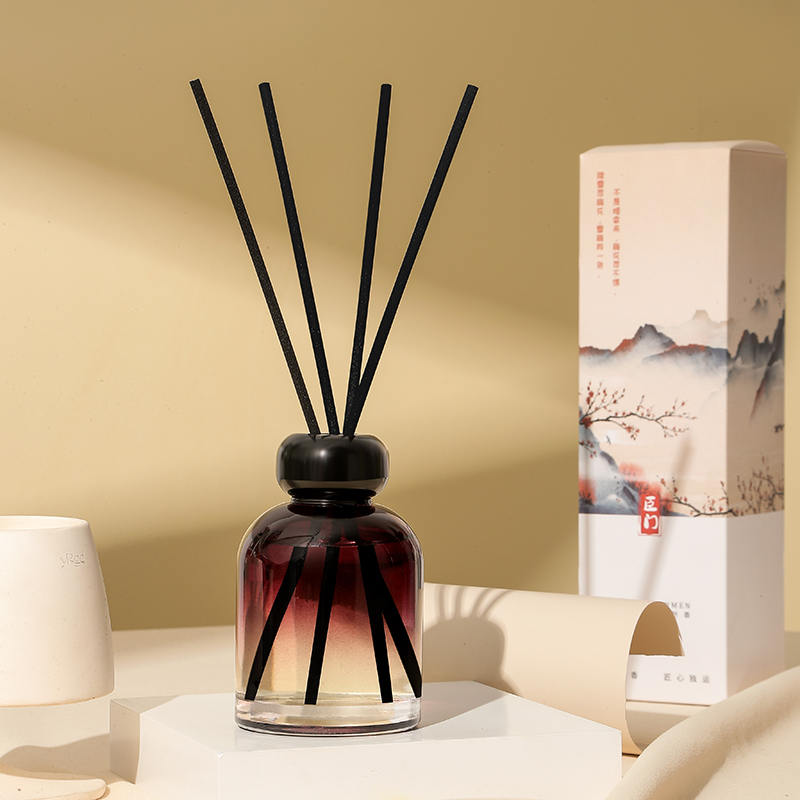
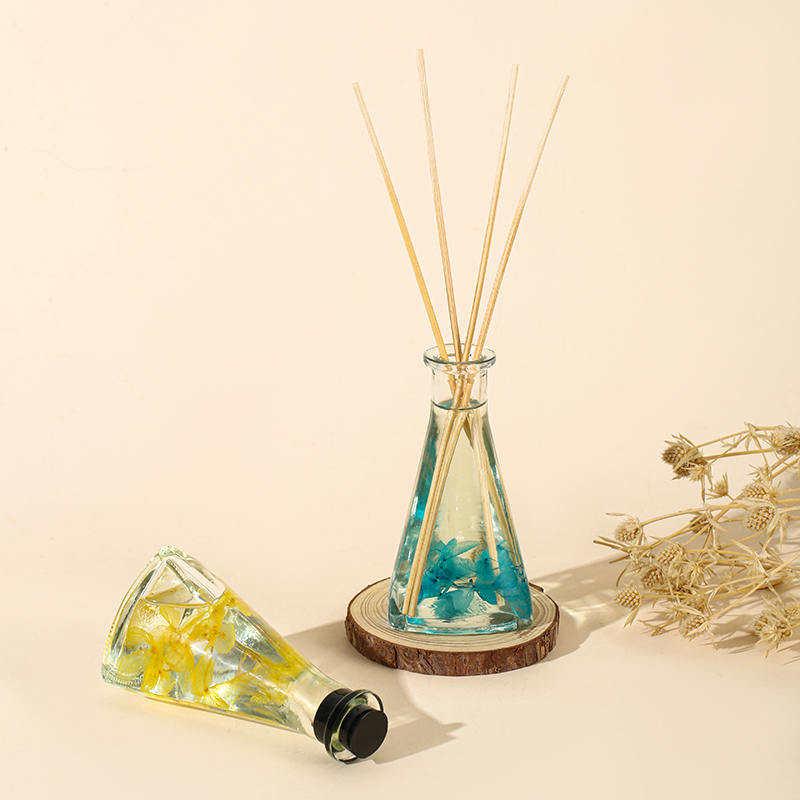 Vine dried flower triangular bottle no fire indoor reed diffuserDiameter 5.5cm, height 10cmView Product →
Decorative flameless diffusers with dried flower or vine detailing sit at the gifting end of this picture. They carry the same continuous release as a plain bottle, but the visible botanical element does the work that packaging cannot, which is helpful in gift channels where the shopper makes a decision in a few seconds.
Sampling, Testing and Compliance for Calming Fragrance Programs
Calming products live or die on how they behave in week four, not on how they smell on the first day. That makes the sampling and testing stage disproportionately important, and it is the part of the process where a supplier's factory discipline shows. A quick development cycle is only valuable if the samples that come out of it are consistent enough to be repeated at production volume.
Scent trials that actually predict reorder rates
A blotter strip tells you what a fragrance concentrate smells like. It does not tell you what a reed diffuser will smell like in a bedroom at eleven at night. For calming ranges we recommend testing the finished product, in the final vessel, with the final reed or wick configuration, at room scale. A practical protocol is three to five rounds of samples, each evaluated by a panel of twenty to thirty people who are not fragrance professionals, in a room of the size the product will be sold for, with the sample placed out of direct airflow.
Two evaluation points matter most. The first is the twenty-minute read, which tells you whether the opening is pleasant and whether it feels calm rather than sharp or sweet. The second is the two-week read for diffusers and the half-burn read for candles, which tells you whether the scent turns flat, soapy or sour as the lighter top notes evaporate away. If a candidate scores well at twenty minutes and poorly at two weeks, the answer is usually a change in the base notes or the carrier, not a higher fragrance load.
Compliance paperwork to collect before the first production run
Home fragrance crosses more regulatory checkpoints than most homeware categories, and collecting the documents early is far cheaper than fixing them after the goods are on the water. At minimum, a calming range should ship with an IFRA conformance statement for the fragrance compound, a safety data sheet, an allergen declaration that satisfies European Union labelling requirements, and a classification and labelling summary where the product falls inside the scope of the relevant hazard rules.
Beyond that, retailers commonly ask for REACH SVHC declarations, California Proposition 65 statements for the relevant substances, and candlestick fire safety testing against the standards their market recognises, such as the ASTM candle fire safety specification in the United States and the corresponding candle labelling standard in Europe. Factory-level social compliance audits, including BSCI and WCA, are usually requested separately, and these are held at the site rather than per product.
Six Sourcing Mistakes That Quietly Undo a Calming Range
Most calming programs fail for reasons that have nothing to do with the quality of the fragrance oil. The mistakes below are the ones we see repeatedly in enquiries, and each one is inexpensive to avoid at the briefing stage.
- Specifying a scent direction without a room size. Calming does not mean the same thing in a 10 square metre bedroom and a 35 square metre living area, and the fragrance load that feels soft in one will feel faint in the other.
- Judging a fragrance from a paper strip. A blotter cannot show how a carrier base behaves over four weeks, how soy wax mutes a top note, or how a sachet performs without airflow.
- Buying reeds on price alone. Cheap reeds with inconsistent channel structure can produce a product that smells strong for a week and then stops, which shows up in reviews long before it shows up in returns data.
- Ignoring transit and warehouse heat. A container that sits on a dock in summer can push evaporation far beyond the lab curve, so a formula that is stable at 22 degrees may need adjustment for long or warm supply chains.
- Writing calming claims without supporting language. Mood-related wording should describe the setting and the moment the product is used in, and stay clear of therapeutic or medical implications that most markets restrict.
- Locking a single SKU instead of a ladder. Calming ranges perform better as an entry, core and value size built from one accord, because the shopper who likes the scent can then trade up or down within the same brand.
Each of these is fixable with a slightly longer briefing conversation. The cost of not fixing them tends to appear in the second season, when the reorder does not come and nobody is quite sure why.
Working With a Calming Home Fragrance Manufacturer
Once the range is specified, the sourcing model decides how quickly it reaches the shelf. A calming collection that spans a diffuser, a candle and a sachet is usually split across two or three vendors unless one manufacturer can cover the whole set, and mixed sourcing adds a surprising amount of coordination work in colour matching, packaging and delivery scheduling.
MOQ, lead times and private label
Minimum order quantities in home fragrance are driven by the fragrance compound, the glass and the printed packaging rather than by the filling line, so a smaller vessel with a stock mould will usually carry a lower entry point than a bespoke bottle. As a working pattern, private label diffuser programs typically start at low four-figure unit quantities per SKU, with candles slightly higher because of wax and wick setup. Production lead time for a repeat order usually runs in the range of three to five weeks after artwork approval, plus transit, and the first run adds sampling and pre-production approval time on top.
The practical advice for buyers is to consolidate. Ordering a diffuser and a candle that share one accord from a single supplier reduces the number of colour and scent matching rounds, simplifies the compliance file, and makes it far easier to launch all three price tiers on the same date.
ODM and OEM: which model fits a calming range
An OEM relationship suits a retailer that already knows exactly what it wants: a defined fragrance direction, a defined bottle, a defined fragrance load and a defined label. The supplier manufactures precisely to that specification and the buyer owns the design work. An ODM relationship suits a retailer that has the shelf space and the brief but not the product, and it is where a manufacturer with an existing library of vessels, reeds, waxes and accords can compress months of development into a shorter cycle.
Most calming programs we run sit in between. The buyer brings the positioning, the price tier and the market, and the manufacturer brings the format, the sizing ladder and the scent options. That split generally gives the fastest route from brief to shelf, because neither side is waiting on the other to invent something that already exists.
Two pages worth opening before you brief
If you want to see how the individual pieces are built, these two pages go deeper into the product line and the scent technology behind it.
- Soy wax scented candle line, covering vessel formats, wax options and the sizes we hold for calming ranges.
- How candle scent intensity and persistence are formulated, useful background when you write claim language for the pack.
FAQ: Calming Home Fragrance Questions From Buyers and Product Teams
These are the questions that come up most often during development conversations, answered in the same terms we would use in a sample review.
What makes a fragrance feel calming rather than sweet or heavy?
Calming usually comes from restraint rather than from a particular ingredient. Accords that read as calm tend to have a soft but clearly defined top note, a warm or powdery heart, and a base that stays quiet after the first hour instead of growing sweeter. Heavy sweetness and very strong gourmand notes tend to read as comforting or festive rather than calming, which is a different shelf position.
Can the same fragrance oil be used in a reed diffuser and a candle?
Often yes, with adjustments. The wax and the diffuser carrier base release notes at different rates, so the same concentrate can smell rounder in one format and thinner in the other. A manufacturer will normally keep one accord and modify the supporting base notes, the load, or both, so the two products stay recognisably the same scent family.
How many reeds should a calming reed diffuser ship with?
Reed count should follow the bottle volume and the neck diameter. As a practical guide, six reeds suit a 100 ml bottle, eight suit 150 ml, and ten to twelve suit 200 to 250 ml. Reeds should also be long enough that most of the evaporating surface sits above the bottle neck, otherwise a large bottle can perform worse than a small one.
Do calming products need allergen and safety documentation?
Yes, and the documents should be ready before production rather than before shipment. A typical file includes an IFRA conformance statement, a safety data sheet, an allergen declaration covering the substances that require labelling in the destination market, and candle safety testing where the product is a candle. Retailers frequently add REACH SVHC and Proposition 65 statements on top of that.
What is a realistic minimum order for a private label calming diffuser?
It depends far more on the bottle and the printed packaging than on the liquid. Stock moulds and stock cartons allow a much lower entry quantity than a bespoke glass shape with custom printing, and a two-SKU launch is usually cheaper per unit than a single SKU launched with heavy custom tooling.
How should calming claim wording be handled on the pack?
Keep the copy descriptive of the setting and the moment. Wording about a quiet room, an evening routine or a softer atmosphere is generally acceptable, while anything that suggests a health or medical benefit moves the product into a different regulatory category in most markets. This is a conversation to have with the compliance file open, not after the artwork is signed off.
Are flameless diffusers the better choice for homes with children or pets?
Flameless formats avoid the open flame, which is the main reason many retailers place them in family-oriented aisles. That said, the oil itself should still carry clear instructions about handling, placement out of reach, and avoiding contact with skin and eyes, because the concentrate is not designed for direct contact.
Which calming format should a first-time buyer start with?
Start with a flameless reed diffuser in the 150 to 200 ml range paired with a mid-size soy wax candle in the same accord. That combination covers continuous background scent and a shorter evening ritual, gives the buyer two price points to test, and generates useful sell-through data before a full three-tier range is committed.
Calming is one of the few home fragrance briefs that rewards a slower brief and a faster decision. The word itself is broad, but the moment it is attached to a room size, a format and a price tier, it becomes a specification that a factory can quote, sample and reproduce at volume. Most of the risk sits in the first two weeks of development, when the format and the sizing ladder are still open, and most of the reward sits in the fourth week after launch, when the customer is still using the product and has stopped noticing it in a good way.
Ningbo Habest Home Co., Ltd. builds calming reed diffusers, scented candles, solid fragrances, sachets, beads and related home fragrance products from a 6,500 square metre facility in Ningbo, China, with five production lines and BSCI as well as WCA factory certifications. We work with supermarket groups, discount networks, brand owners and distributors on ODM and OEM programs across Japan, the United States, the European Union and the United Kingdom, covering development, raw material control, manufacturing, quality inspection, warehousing and shipping under one roof. If you are building a calming range and want a sizing ladder and a scent shortlist against your shelf, send us the room size, the price tier and the market, and we will work backwards from the shopper's evening.


 INTERACT WITH US
- Phone:+86-15888548612
- Tel:+86-0574-88408268
- E-mail:[email protected]
- Address:312 Kemao Road, Jishigang Town, Haishu District, Ningbo City, Zhejiang Province, China.



