
 English
 Español
 عربى
عربى
Office Diffuser Buying Guide: Sizing, Reed Counts and Refills for B2B Teams
Content
- 1 Why Office Diffuser Programs Break Down in the First Month
- 2 How a Reed Diffuser Moves Fragrance Through an Office
- 3 Sizing Table: Matching Bottle Volume and Reed Count to Room Volume
- 4 Choosing Scents for Shared, Air-Conditioned Workplaces
- 5 Comparison Chart: Fragrance Throw by Diffuser Format
- 6 Client-Facing Spaces: Reception, Showroom and Hotel-Style Standards
- 7 Desk-Level and Cubicle Options
- 8 Writing an Office Diffuser Specification for an RFQ
- 9 Compliance, Testing and Documentation Buyers Should Receive
- 10 Maintenance Schedule for Offices and Hotel Floors
- 11 Working With a Manufacturer: OEM, ODM and Private Label Terms
- 12 Frequently Asked Questions About Office Diffusers
- 12.1 How many office diffusers do I need for an open-plan office?
- 12.2 Are reed diffusers safe in an office with no opening windows?
- 12.3 How long does a 180 ml office diffuser last?
- 12.4 Can we use the same fragrance in every room?
- 12.5 What is the difference between rattan and fibre reeds?
- 12.6 Do office diffusers need electricity?
- 12.7 How do we stop the scent from giving people headaches?
- 12.8 What is the minimum order quantity for a private label office diffuser?
- 12.9 Can reed diffuser oil damage desks or laminate?
- 12.10 Which certifications should an office diffuser supplier hold?
- 13 Where to Go Next: Related Pages and Resources
A forty-bottle order arrives at a sixty-desk office. Within two weeks the reception area smells like a candle shop, the second-floor meeting rooms smell of nothing at all, and three employees have emailed facilities asking for every bottle to be removed. Nothing was wrong with the purchase order, the paperwork or the delivery date. The sizing logic behind the order was wrong, and no one had written down who would change the reeds.
Office diffuser projects succeed or fail on three numbers: the cubic volume of the space being scented, the number of reeds standing in the bottle, and the number of days between refills. Align those three and the fragrance drops into the background, which is exactly where it belongs in a workplace. Misalign them and the same product that reads as calm and expensive in a hotel corridor becomes an HR complaint in a shared office.
This guide is written for the people who actually sign the paper: facility managers, office administrators, procurement officers, importers, distributors, hotel groups and private label brands sourcing office diffusers in volume. It covers room-by-room sizing, the mechanics that decide how far a scent travels, a comparison of fragrance throw across common formats, the specifications worth writing into an RFQ, the documentation a manufacturer should hand over with every shipment, a maintenance schedule a real facilities team can follow, and the questions buyers ask most often before a first or repeat order.
Why Office Diffuser Programs Break Down in the First Month
Most failures are predictable, and almost none of them are caused by a bad fragrance. They come from five decisions that look harmless on a purchase order.
Buying on unit price alone. A cheaper bottle usually saves money on glass thickness, reed quality or fragrance load. Thinner glass raises breakage in transit; low-grade rattan reeds vary in porosity from stick to stick, so two bottles from the same carton can perform differently. The saving is visible on the invoice and invisible until the complaints arrive.
Ignoring the air change rate. A mechanically ventilated office typically moves four to eight volumes of air per hour. A diffuser placed under a supply vent is diluted continuously, while one sitting near a return grille can concentrate volatiles in a small area. Two identical bottles in the same room, one metre apart, can produce noticeably different results.
Uniform dosing across unequal rooms. A private office of roughly thirty-five cubic metres and an open-plan zone of three hundred cubic metres do not belong in the same line item at the same quantity. Volume drives the requirement; headcount and foot traffic modify it.
Treating reed count as decoration. Reeds are the throttle. Going from four reeds to eight can raise measured throw by roughly forty-five to sixty percent and cut service life by a similar proportion. A team that adds reeds to fix a weak room will also accelerate oil consumption, and the refill budget will not match the original forecast.
No named owner for maintenance. Oil top-ups, reed replacement and leak checks are small tasks that disappear the moment the office administrator changes roles. Without a schedule and a name against each line, the diffusers run dry and the program is quietly abandoned.
Sensitivity issues sit alongside these. Fragrance-free policies, asthma, migraine triggers and personal preference are real constraints. A policy that allows scent in reception and meeting rooms but keeps open-plan desks neutral is usually easier to defend than a blanket approval, and it is far easier to explain to a new hire than an exception made for one team.
How a Reed Diffuser Moves Fragrance Through an Office
A reed diffuser has no fan, no heat and no power supply. Fragrance oil climbs through narrow channels inside each reed by capillary action, reaches the exposed surface, and evaporates into the air. Air movement then carries the molecules across the room, and the smell you notice is the fraction that reaches a nose before it is diluted or absorbed.
That simple sequence explains almost every field problem. Wick rate depends on the internal structure of the reed, the viscosity of the oil and the ambient temperature. Evaporation rate depends on the exposed surface area, which is a function of reed count, reed diameter and how far the reeds spread. Distribution depends entirely on air currents, which is why placement beats bottle size in most offices.
Reed material matters more than most buyers expect. Natural rattan is traditional, photographs well and suits hospitality interiors, but its porosity varies between harvests, so wicking can be uneven across a bundle. Fibre reeds built around a synthetic core give a more consistent channel, wick faster and tend to deliver a steadier release over the first three weeks. For large programs, the practical approach is to approve one reed specification, test it, and hold it, rather than accepting whatever arrives with a lower-priced batch.
Reed flipping is a maintenance action with a measurable effect. Turning the bundle every seven to fourteen days clears dust from the exposed surface and re-wets the upper section, restoring output. Flipping more often than once a week simply empties the bottle faster, because it repeatedly exposes fresh, saturated surfaces to moving air.
Finally, bottle geometry is not purely aesthetic. A narrow neck reduces the free liquid surface and slows the initial release, so a tall triangular bottle often reads gentler than its volume suggests. A wide-mouth jar releases more aggressively at the same fill level. If a design change moves from a narrow neck to a wide one, expect the room to feel stronger even when the oil weight is unchanged.
Sizing Table: Matching Bottle Volume and Reed Count to Room Volume
The figures below assume a normal office environment of twenty to twenty-three degrees Celsius with four to six air changes per hour. Warmer, draughtier rooms shorten every service life. Cold, still rooms stretch it.
| Space type | Typical volume | Recommended bottle | Reed count | Expected service life | Placement note |
|---|---|---|---|---|---|
| Single desk or cubicle | 10 to 15 m3 | 60 to 120 ml | 4 to 5 reeds | 6 to 8 weeks | At the far edge of the desk, away from monitor fans |
| Private office | 30 to 45 m3 | 120 to 150 ml | 5 to 6 reeds | 6 to 8 weeks | On a shelf 1.2 to 1.5 m high, near the door |
| Meeting room | 50 to 90 m3 | 180 to 200 ml | 6 to 8 reeds | 5 to 7 weeks | Two units at opposite corners, never on the table |
| Open-plan zone | 200 to 500 m3 | Two to four bottles of 200 to 250 ml | 8 reeds each | 4 to 6 weeks | Zone the floor and check the air change rate first |
| Reception or showroom | 150 to 400 m3 | 250 ml or larger | 8 to 10 reeds | 4 to 5 weeks | Out of reach, clear of door draughts and return grilles |
The 180 ml band is the workhorse of commercial office supply. It covers a private office generously and a small meeting room comfortably, and it is small enough to correct with reed count if the room turns out to be draughtier than expected.
 180ml Household bedroom fireless reed diffuserPlant Extract Volatile SolutionView Product →
Before rolling a format out across a floor, run a two-week trial in three rooms of different sizes. Place the unit, run the normal ventilation schedule, and ask three people to describe what they notice at 30 cm, 1.5 m and 3 m. If the answer at 3 m is "nothing", the format is correctly tuned for a private office but too small for open plan. If the answer at 3 m is "strong", the reed count should come down before the order is scaled.
Fragrance selection is a design decision with a technical ceiling. The question is not which scent is most attractive, but which scent performs predictably in a closed, recycled-air environment where the same people sit for eight hours a day.
For reception and showroom areas, citrus, bergamot, green tea, fig and soft floral blends work well because visits are short and the fragrance is part of the first impression. For meeting rooms, herbal and aromatic families such as rosemary, eucalyptus, basil and light woody notes are generally better tolerated than heavy gourmand blends, which can feel cloying in a room with the door closed. For open-plan floors, the safest profile is a clean cotton, white musk, bamboo or very light green accord at reduced output. Strong amber, oud and vanilla profiles belong in hospitality lobbies and retail environments, not above a bank of desks.
Concentration is frequently misunderstood. Fragrance oil load in a reed diffuser base commonly sits between ten and twenty percent by weight. Raising the load does not automatically raise perceived strength, because a heavier carrier oil evaporates more slowly and can reduce the initial burst. What buyers should ask for is the actual load, the base oil and the IFRA certificate for the finished formulation, not a marketing number.
Compliance is part of scent selection. IFRA Standards set maximum use levels per product category, and air care formats such as reed diffusers sit in a specific category within that framework. Ask the supplier to name the category and the amendment number used in the assessment. In the European Union, fragrance allergens must be declared on the label above the applicable threshold, and a safety data sheet should be available for every finished scent. For North American retail programs, additional restricted substance screening may be requested by the customer's own compliance team.
A practical testing routine is worth more than a catalogue. Shortlist three scents, place one unit of each in an identical room, keep the reed count identical, and survey staff after five working days. Two questions are enough: is the scent noticeable in a positive way, and would you be comfortable with it for a full working year? A scent that wins the first question and loses the second is a seasonal option, not a program standard.
Comparison Chart: Fragrance Throw by Diffuser Format
Before choosing a bottle, it helps to see what each format actually delivers in a room. Fragrance throw is not the same as oil volume, because a 120 ml bottle with five fibre reeds can outperform a 250 ml bottle whose reeds have clogged with dust and oxidised oil. The comparison below uses an index built from controlled placements in a sixty cubic metre test room at twenty-one degrees Celsius with roughly five air changes per hour. Trained assessors scored each format at 30 cm, 1.5 m and 3 m over a twenty-one-day period, with reed maintenance performed on the same schedule. The scores are relative rather than absolute: an index of 100 marks the strongest sustained throw in the set, not a laboratory concentration. Formats were filled with the same base oil and the same fragrance load so that only the hardware changed. The chart is intended as a planning tool for buyers comparing formats, not as a substitute for a trial in the actual room.
The 250 ml bottle with eight rattan reeds sets the ceiling of the scale, and it earns that position mainly in the first three weeks. After that, the reeds saturate, the oil level drops and the exposed wetted surface shrinks, so the gap between the largest and mid-size formats narrows considerably in the final week of the test.
The 180 ml six-reed format sits at 84 on the index, which is why it ends up in so many mid-size offices. It is close enough to the ceiling to fill a meeting room without overwhelming a corridor, and it leaves enough headroom that a slightly larger room can be corrected by adding a reed rather than by re-ordering a different bottle size.
The 120 ml unit with five fibre reeds scores 66 and punches above its volume. Fibre reeds have a more consistent internal channel than natural rattan, so wicking is even, the first week is strong and the release curve is flatter. Buyers who need predictable output from a compact bottle should weigh reed construction as heavily as bottle size.
The 100 ml desk unit at 52 is designed for personal space, not for rooms. In a sixty cubic metre space it becomes barely detectable after an hour, which is precisely the behaviour a workstation unit should have. Placed within 40 cm of a seated user, it reads clearly; placed in a meeting room, it disappears.
The bead jar and the pearl-style passive unit sit at the bottom of the scale, at 41 and 34. Both rely on a smaller exposed surface and a slower release mechanism, so they suit enclosed small spaces, cupboards, lockers and desk drawers rather than circulation areas. Their advantage is that they are almost impossible to over-apply, which matters in scent-sensitive buildings.
The relationship between hardware and performance is not linear. Doubling reed count from four to eight typically raises measured throw by forty-five to sixty percent rather than one hundred percent, because reeds near the centre of a bundle are partly shielded from airflow by the outer sticks. Spreading a bundle into a fan shape recovers some of that loss without adding oil consumption.
Time on the scale also matters. The strongest format in week one is not always the strongest in week four, because the volatile top notes evaporate first and the remaining base notes behave differently at the wick surface. This is why a scent that smells bright on day one can smell flat and heavy by day twenty, even when the oil level is unchanged.
Bottle geometry plays a supporting role. A narrow neck reduces free liquid surface and softens the initial release, so tall triangular designs often read gentler than their volume suggests. A wide-mouth jar with the same fill weight releases more aggressively and drains faster in a draughty room.
Temperature remains the largest single variable in the field. A room at twenty-four degrees Celsius releases fragrance noticeably faster than the same room at nineteen degrees, and the difference widens as airflow increases. Offices that run warm in summer and cool in winter will see two different service lives from the same SKU.
For a facilities team, the practical reading of the index is to select one step larger than the measured requirement and then throttle output with reed count. A large bottle with fewer reeds is easy to adjust upward next month; a small bottle that cannot keep up has no spare capacity at all.
Finally, treat the index as a planning tool rather than a promise. The same bottle that scores 84 in a neutral test room can read far stronger in a glass-walled corner office with a supply diffuser overhead, and far weaker in a partitioned interior room with the door closed. The room, not the chart, makes the final decision.
Client-Facing Spaces: Reception, Showroom and Hotel-Style Standards
Reception areas carry a different brief from the rest of the building. The scent has to be present when a visitor walks through the door, stable across a whole working month, and strong enough to be remembered without being strong enough to be described. Hotels solved this problem long ago, and the same principles transfer directly to offices and showrooms.
The first principle is consistency over intensity. A signature scent that smells the same in September and in March builds recognition; a rotation of seasonal blends creates the impression of a space that cannot decide what it is. The second principle is distance. Ambient scent in a lobby is normally tuned so that it is clearly detectable within two to three metres of the entrance and barely noticeable at the far end of the space. The third principle is visual discipline: the hardware is part of the interior, so bottle finish, reed colour and tray design should match the furniture rather than the warehouse.
Operationally, reception formats should be sized one band larger than a private office of the same volume, because door traffic constantly flushes the space with outside air. A 250 ml bottle with eight reeds, topped up on a four-week cycle and re-reeded every eight to ten weeks, holds a steady level through normal business hours. Bottles should sit at 1.2 to 1.5 metres, on a tray, away from polished wood and upholstery, and well clear of the main door draught and any ceiling supply diffuser.
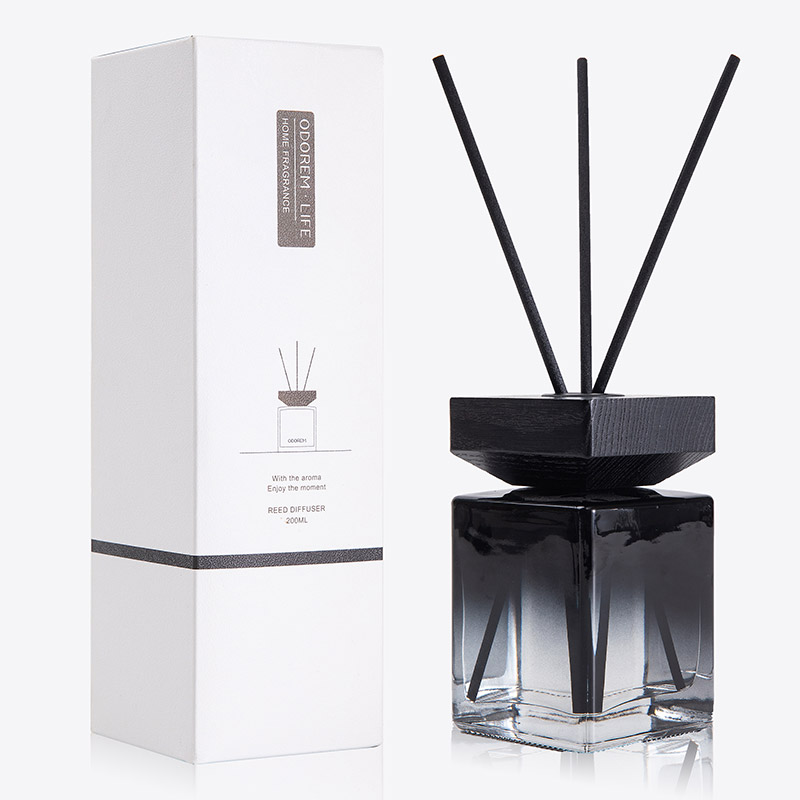
Where the bottle is part of the visual merchandising, a dark glass or decorated format keeps the display consistent while the oil does the work. A dark bottle with dried botanical decoration, for example, can sit on a reception console through every season without looking out of place, and the fragrance can be changed at the refill stage without changing what the visitor sees.
 Black bottle dried flower hotel no fire reed diffuserApproximately 2 monthsView Product →
Showrooms need one further consideration: sample handling. A scent should not compete with materials, textiles, leather or food samples. If the showroom hosts product demonstrations, keep the diffuser in the entry zone and let the display area stay neutral.
Desk-Level and Cubicle Options
Personal diffusers solve a specific problem: a single workstation in an otherwise neutral floor. They also create a specific risk. A passive unit that is pleasant at 40 cm can be intrusive at 1.5 m in the next pod, and in an open-plan office nobody controls which way the air moves.
The engineering answer is to keep output low and surface area small. Units of 60 to 120 ml with four to five reeds are appropriate for desk use, particularly decorated formats that hold fragrance in a bead or pearl layer rather than an open pool of oil. Because the release is gradual, these designs rarely overwhelm a neighbouring desk, and they can be removed at the end of a working day without leaving a strong residue in the air.
Placement follows the same logic. Keep the unit at the far edge of the desk, away from the monitor fan, away from the keyboard, and never directly beneath the seated user's nose. Flip reeds once a month for these small formats rather than weekly, since the objective is a steady background note, not maximum output.
Procurement for personal units should still follow a schedule. Specify a fixed replacement cycle of sixty to ninety days for the unit and ninety days for the reeds, and include it in the same maintenance sheet as the room diffusers. When personal units are treated as discretionary desk accessories, they accumulate on a floor by accident, and the aggregate scent load becomes impossible to manage.
 Pearl style flameless reed diffuserFragrance dispersal timeView Product →
The pearl-style passive format is a useful reference point for this category because its release curve is gentle by design. It suits a single desk, a small enclosed office or a locker area, and it fails predictably in a large open plan where the volume simply overwhelms a low-output unit.
Writing an Office Diffuser Specification for an RFQ
Most disputes between an office buyer and a supplier are not arguments about quality. They are arguments about what was never written down. A one-page specification attached to the purchase order removes more friction than a year of email confirmations.
| Specification item | What to state | Typical tolerance or note |
|---|---|---|
| Filled volume | Millilitres of fragrance oil per bottle | Plus or minus three percent on filled weight |
| Fragrance load | Percent by weight of fragrance concentrate in the base | State base oil type and IFRA category used |
| Reed specification | Material, length, diameter, count, colour | Fibre core or natural rattan, approved against a sealed sample |
| Bottle and finish | Capacity, glass colour, neck thread, decoration | Approved pre-production sample retained by both parties |
| Leak performance | Upright and inverted leak test at elevated temperature | Twenty-four hours at forty degrees Celsius, no seepage |
| Transport performance | Carton drop test before shipment | Per the buyer's chosen test protocol for the destination market |
| Labelling | Allergen declaration, batch code, best-before, origin | Artwork approved in final print-ready form |
| Commercial terms | MOQ per SKU and per scent, sample lead time, production lead time | State Incoterm, payment schedule and inspection method |
Two further clauses are worth adding for multi-site buyers. The first is a batch retention clause: the supplier keeps a sealed reference sample from every production batch for a defined period, so a later complaint can be compared against the actual goods. The second is a scent consistency clause describing how deviation is measured, usually by side-by-side olfactory comparison against the approved reference by two people, with a defined rework or credit remedy.
Buyers running a single office rarely need all of this. Buyers rolling out forty sites in three countries need every line of it, because a fragrance that drifts between batches becomes a visible inconsistency across a portfolio.
Compliance, Testing and Documentation Buyers Should Receive
For retail chains, hotel groups and distributors, documentation is part of the product. A supplier that cannot produce paperwork on request creates a risk that sits with the buyer in the destination market, not with the factory.
Factory level documentation usually starts with social compliance audits. BSCI and WCA audits are common requirements for suppliers serving European and North American retail programs, and they cover working conditions, safety and environmental practices rather than the product itself. A current audit report, with the date and the audit body visible, is the normal starting point for a public tender or a retail onboarding file.
Product level documentation should include a safety data sheet for each finished fragrance, an IFRA certificate naming the category and amendment used, and a certificate of analysis for the batch covering fill weight, fragrance load and appearance. For European distribution, allergen labelling and restricted substance compliance sit with the brand owner, and the supplier should be able to confirm the fragrance formulation against the relevant screening list. For North American distribution, additional state-level screening may be requested by the customer's own compliance team.
Transport documentation depends on flashpoint. Many fragrance oils used in reed diffusers have a flashpoint high enough to fall outside flammable liquid classification for shipping, but this must be confirmed by test rather than assumed, because a change of base oil or fragrance load can move a product across the threshold. Ask for the test method and result with each new formulation, not once at the beginning of the relationship.
Finally, traceability. A batch code that links a finished bottle to a filling date, a fragrance lot and a glass lot is the minimum needed to investigate a complaint. Suppliers with in-house blending and filling control this chain internally, which shortens the response time when something goes wrong.
Maintenance Schedule for Offices and Hotel Floors
A diffuser program survives on a schedule that someone can actually complete in ten minutes a week. The table below is designed for an office administrator or housekeeping supervisor working from a single checklist.
| Task | Frequency | Owner | Notes |
|---|---|---|---|
| Visual leak and ring check | Weekly | Office administrator | Wipe bottle neck and tray with a dry cloth |
| Flip the reed bundle | Every 7 to 14 days | Office administrator | Do not flip more than once a week in small rooms |
| Top up oil to the fill line | Every 3 to 4 weeks | Facilities | Never add water and never mix two scents in one bottle |
| Replace reeds | Every 8 to 12 weeks | Facilities | Replace rather than wash; clogged reeds are the main cause of fading |
| Full clean and reset | Quarterly | Facilities | Empty, clean, dry and refill with fresh oil and fresh reeds |
| Scent perception check | Twice a year | Facilities and HR | Record comments and adjust reed count before changing the scent |
| Stock and refill audit | Monthly | Purchasing | Compare consumption against the annual forecast |
Three rules prevent most problems. Replace reeds on schedule instead of waiting for the scent to fade, because a clogged reed bundle reduces output long before the oil runs out. Never top up a bottle that has been standing open for weeks without cleaning it first. And store spare oil closed, upright and out of direct sunlight, since heat and light accelerate oxidation and change the top notes.
A maintenance sheet also gives procurement a real consumption number. After one quarter, the refill usage per site tells you more about the correct specification than any sizing table, because it reflects the actual ventilation, temperature and traffic of the building.
Working With a Manufacturer: OEM, ODM and Private Label Terms
Once a specification is stable, the conversation shifts from product to supply. Office diffusers are a glass-heavy, fragrance-heavy category, and the commercial terms around them follow a fairly predictable pattern at a professional supplier.
The three sourcing models are worth separating. In OEM production, the buyer supplies the design, the glass shape, the fragrance brief and the packaging, and the factory manufactures to that specification. In ODM production, the buyer selects from the manufacturer's existing designs and scent library and applies its own branding, which shortens development significantly. Private label sits between the two, usually meaning a standard bottle with custom label, colour and scent selection but no new tooling.
Minimum order quantities vary by component. Standard glass bottles with existing moulds typically start around one thousand pieces per SKU per scent, while a new bottle mould can require three thousand pieces or more plus a tooling fee and additional development time. Scent development from a brief usually takes two to three weeks for a first submission, with one or two revision rounds before approval. Sample lead time of seven to fifteen days and production lead time of twenty-five to forty days are common for a factory with in-house blending and filling.
For multi-market buyers, the practical differentiator is capacity and consistency. A manufacturer operating several production lines with in-house fragrance blending controls batch-to-batch variation more tightly than an assembler that buys filled bottles from third parties, and it can respond faster when a scent needs adjustment. Facilities covering six thousand five hundred square metres and five production lines represent a scale that suits retail and hospitality programs rather than one-off orders.
Commercially, buyers should agree on Incoterms and inspection method before the first production run, not after. Volume price breaks are normally quoted per container or per pallet, and wholesalers and distributors often negotiate territory or channel terms alongside price. Where a program spans multiple countries, the supplier should also confirm that packaging and labelling can be produced in the destination language and to the destination market's requirements.
Frequently Asked Questions About Office Diffusers
How many office diffusers do I need for an open-plan office?
Divide the floor into zones of roughly two hundred to three hundred cubic metres and place two to four hundred millilitre bottles with eight reeds per zone, positioned at opposite corners rather than in the centre. Check the air change rate before finalising quantities, because a floor with high mechanical ventilation can need more coverage than the same floor with natural ventilation.
Are reed diffusers safe in an office with no opening windows?
Reed diffusers are unpowered and produce no combustion, which makes them suitable for sealed buildings. The practical limits are fragrance load and ventilation. In a fully enclosed space, keep the scent light, keep bottles away from supply vents and return grilles, and review the program if anyone reports headaches or irritation.
How long does a 180 ml office diffuser last?
In a typical office environment of twenty to twenty-three degrees Celsius with four to six air changes per hour, expect five to seven weeks from a six-reed set. Warmer rooms, stronger airflow or a higher reed count will shorten that period; cooler and stiller rooms will extend it.
Can we use the same fragrance in every room?
You can, but it is rarely the best choice. A signature scent in reception, a lighter variant in open-plan areas and an aromatic profile in meeting rooms gives each zone an appropriate level without forcing one intensity across the whole building. Consistency of family, rather than identity of scent, is usually the better rule.
What is the difference between rattan and fibre reeds?
Rattan is a natural material with variable porosity, which suits traditional and hospitality designs but can produce uneven wicking between sticks. Fibre reeds use a synthetic core for a more consistent internal channel, deliver a steadier release curve and are easier to standardise across large orders. Both should be approved against a sealed sample.
Do office diffusers need electricity?
Passive reed diffusers do not require power, batteries or installation, which is one reason they dominate office and hotel applications. Powered aroma systems exist for very large areas, but they introduce cabling, maintenance and noise considerations that passive formats avoid.
How do we stop the scent from giving people headaches?
Reduce output before reducing quality. Lower the reed count, move the unit further from occupied seating, and choose a lighter fragrance family for shared areas. Survey staff after one week and treat negative feedback as a specification input rather than a personal objection.
What is the minimum order quantity for a private label office diffuser?
Standard bottles with existing moulds commonly start around one thousand pieces per SKU per scent. A new bottle mould raises the threshold, adds a tooling charge and extends development time. Buyers should confirm MOQ per SKU, per scent and per carton before artwork is finalised.
Can reed diffuser oil damage desks or laminate?
Fragrance oil can leave marks on polished wood, laminate and some upholstery if it spills or seeps. Use a tray or coaster, keep the bottle upright, wipe the neck after refilling and avoid placing units where they can be knocked over by passing traffic.
Which certifications should an office diffuser supplier hold?
Social compliance audits such as BSCI and WCA are the usual baseline for retail and hospitality programs. On the product side, ask for safety data sheets, IFRA documentation naming the category and amendment used, and batch certificates of analysis. The combination gives the buyer a defensible file in the destination market.
Where to Go Next: Related Pages and Resources
Two pages are worth reading before a specification is finalised. The first explains how the components of a reed diffuser work together and why reed material changes performance between batches. The second lists the reed diffuser formats available from the workshop, from small desk units to large reception bottles, which makes it easier to match a format to a room before requesting samples.
Reference pages
For buyers comparing several rooms at once, the most efficient next step is to request two or three formats at the sizes suggested in Table 1, run them in the actual spaces for two weeks, and let the maintenance log decide the final specification. That approach costs a little more at the sampling stage and considerably less at the rollout stage.
An office diffuser is a small object with an outsized effect on how a space feels. It is also a product with measurable variables: room volume, air change rate, reed count, fragrance load, bottle geometry and replacement interval. Treat those variables as engineering inputs rather than preferences, and the fragrance becomes a reliable part of the environment instead of a recurring argument.
Start with one floor and one format. Document the room volumes, record the refill dates, keep the reeds on schedule, and review the results after a full quarter. The data that comes back will tell you more about the correct specification than any catalogue, and the same numbers will make the next forty sites straightforward.



 INTERACT WITH US
- Phone:+86-15888548612
- Tel:+86-0574-88408268
- E-mail:[email protected]
- Address:312 Kemao Road, Jishigang Town, Haishu District, Ningbo City, Zhejiang Province, China.



